Tuesday, October 09, 2007

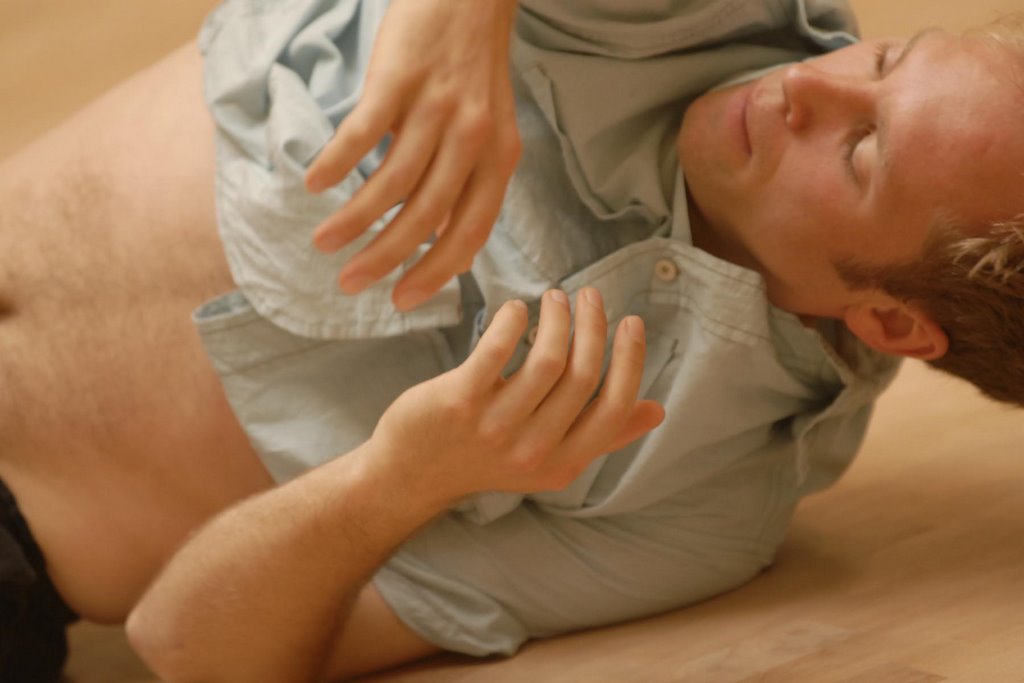
Am I my body?


I.
I am my body. What do I become
with every new situation?
I am everything else
other than my body, I am your body too
and the space our bodies share.
The body is relational. I am my body in
reference to what my body
is not. My body is occuring in that moment -
under those circumstances.
I am not my body that I was a moment ago.
I am my body also.

II.
Methinks that in looking at things
spiritual, we are like oysters observing the
sun through the water, and thinking
that thick water the thinnest of air.
Methinks my body is but the lees of my
better being. In fact take my body who
will, take it I say, it is not me.

Herman Melville - Mody Dick

Wednesday, August 29, 2007

on improvising

Improvisation bridges the space between my physical sense of
self and a physical sense of what my self is not. It is the manafest
dialogue between my edges and the worlds edges, including all people,
living things and objects within the world.
It is a language of my skin. It is a form that emerges
before i know. It is a form of me.

Pollack the movement.
The record of the movement.
The drip is the residue of the action.
The action is the conversation.

Isn’t that what we are always requiring in our
work as dancers, the attempt to crystallize a
moment of the passing stream of living. A
dancer is in the profession of living ones life in front of
people and among people. To me that is the ultimate
function of dance, to help others feel themselves by
means of acting as a surrogate channel for experience.
Our job is to place ourselves within an accessible proximity
to people and attempt to deliver a honest and direct report
of the state of ourselves, in order that we may be able to
allow others to access some range of this state within
themselves.

My mother said the other night that a dancer is a form of
being an exhibitionist, but I think what she really means
is that as a dancer I put myself - as a person in process,
one dance at a time – in front of others to communicate
through the bodies histories and languages. The language
of the body is a shared fluency, if allowed.

Given the fact that we can never not be a body is an incredible
thing. We are body, we are the drips of a Pollack painting every
moment of our lives.

Tuesday, August 28, 2007

Ucross Foundation 3/07


During March of 2007 my company The Foundry was in residence
at the Ucross Foundation in rural Wyoming creating Imprint.
During this period me, as well as the rest of our collaborators
took the time each day to embark on a daily practice that helped
to inspire and focus and primarily to engage with the extraordinary
landscape and history of the region. In my case, I walked in the
mornings. At a certain point within the walk I would stop, take in
the immediate snapshot of where I was and jot down quick
observations based on the near/distant. From that location I
would then count the steps back to a certain end point, often
not based on returning home, but a specified end point. Something
about measuring a distance of space within the total space of a
journey resonates with me. Spaces within spaces - distances within
distance. Measurable performances within a daily activity. Activity
as performing action, logging the action as performing memory.
This is one of my daily logs of such a walk.

Ucross Foundation, Ucross Wyoming – day 3
3/8/07

7:30am walk

up dirt road into hills across the road.

Step count on return – last portion of walk only:
547 steps – from last portion of dirt road leading to highway
to Ucross population sign posted on highway.

Observations:
*Big puddle – thin ice
*old barn new roof
*barb wire / aged wood
*frozen animal tracks
*air conditioner system mounted on bunker block

Friday, August 17, 2007

keith Jarret on Improvising

Here are a some informative quotes on the process
and sensibility of Improvising by one of the musical masters of
the form. Listening and reading the work of Jarret has inpired and
reaffirmed my own experiences about what it can mean to give
over to an unknown space, in my case through dance, into creation.


Inside out: Thoughts on free playing
by Keith Jarrett
"It really depends on whether a player ‘conceives of
nothing’ as the ‘lack of something’, or pregnant with
‘everything’. Then, further, it depends on what
‘everything’ means to that player. If it means something
limiting, if it scares him his ability as a free player will be
stunted also. We all have a structure to our bodies.
The only limit, it would seem to me, is what the body
cannot do."

"There were at least 3 people involved at a solo concert
(which was always improvised from scratch): the improviser,
the spontaneous composer, and the listener at the keyboard.
The improviser is the easiest to explain (though none in their
right mind would try to). He sits there confident in his ability
to find some musical way from a - b (although he has no idea
what b is). The spontaneous composer is a little harder to
explain, though his position is slightly above the improviser.
He ‘sends down’ material (sorry, it’s the only way I know to
say it) at the spur of the moment whenever the improviser calls
for it. He might have to create out of thin air. His job is harder
because he has to supply substantialcontent on the spur of the
moment, in case the improviser gets stuck or lost or just plain
looses his connection to ‘the zone’. The composer eggs on the
improviser (and visa versa), while the man at the key board -
monitoring the proceedings and trying not to judge too quickly
or intervene, even when he disapproves - attempts to pay attention
to it all, simultaneously (all of this is simultaneous) checking his
vital functions for any abnormalities, making sure he has no finger
or body cramps and than he has drawn a breath recently, etc."

Scattered Words
by Keith Jarrett
"All of these pieces are born of a desire to praise and contemplate
rather than a desire to “make” or “show” or “demonstrate” something
unique. they are, in a certain way, prayers that beauty will be made
acceptable despite fashions, intellect, analysis, progress, technology,
distraction, “burning issues” of the day, the un-hipness of belief or
faith, concert programming, and the unnatural “scene’” of “art”, the
market, lifestyles etc., etc... I am not attempting to be a composer,
I am trying to reveal a state I think is missing in today's world (accept,
perhaps in private): a certain state of surrender."

Casina Setartta, Puglia Italy July 2007 - Improvising for Performance Research Project lead by Kirstie Simson and a group of international dancers


Monday, August 13, 2007

Brussels Performance - Andrew Morrish, Kirstie Simson, Christian Burns


Dance Is Transportation

The body of dance is the body of

Points of body travel through trajectories

The travel mode of movement

Trans – portation

The function of transportation is to achieve the goal of moving from one location to another. The notion that the object of this action is only of a singular body is part of the potential of...

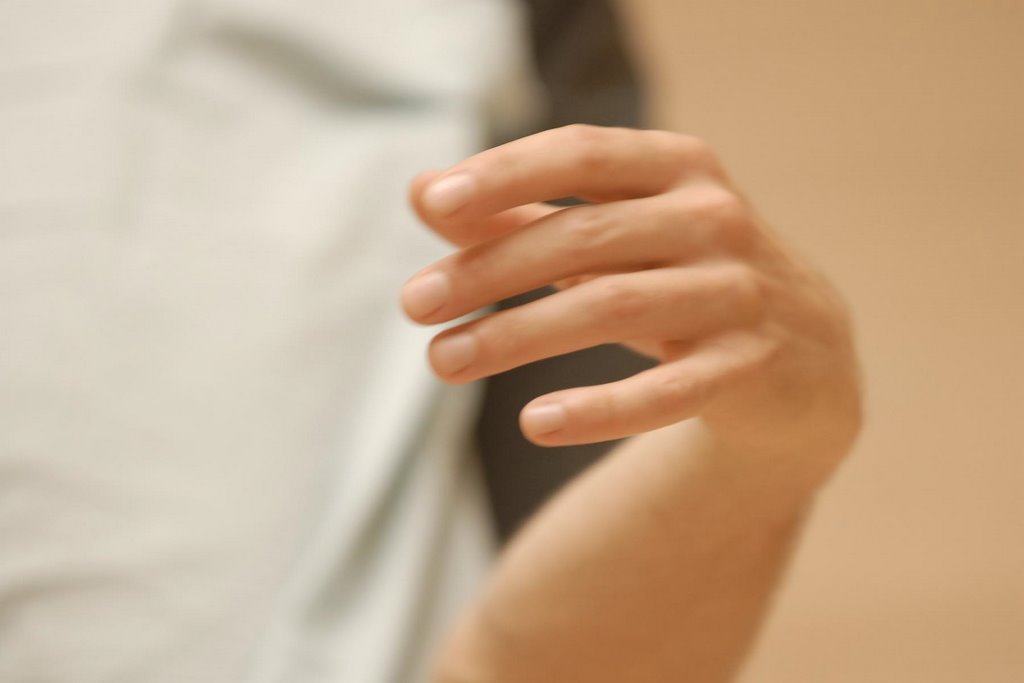
The journey of the hand is the body of a traveler

The body of the head is the body of a traveler

The memory of the knee is the body of a traveler

Each point of the body (down to the smallest measurable component) has a potential for trajectory and transportation. The idea of these individual points of the body, as being individual intelligences, that gather, experience and notate experience, is for me the most interesting and curious aspect of my dance experience these days.

How could you manage to illustrate these individual trajectories, so that the unison of their multiple directive points are seen as a weave of one fabric. Where are they going and what are they serving. Are they aware of what their work is?

Head moves around while elbow dips in counter circles and hips duck and rise. These are obvious and familiar body associations, but how about if it was more deeply drawn from, such as the specific nerve ending at the rim of the fourth vertebrae, and the inner marrow cavity of the upper left femur and the specific tonsil of the right bottom edge of the throat. A single strand of hair or a point under at toenail or line along the right heart ventricle. It can go on and on, every single molecular point of matter has its own sense of transportation, within the confine of a larger body. Not unlike the body of our planet and the minuscule movements of tiny organisms (Us for example) in combination with other organisms and flora/fauna/geology.

Sunday, October 22, 2006

Theater and Seeing

I have been in residence for the past three weeks with my collaborative The Foundry making a new work titled Imprint. The Santa Fe Art Institute has been our host for this residency and we have basically spent most of our waking hours in the studio working and creating raw material for the future next residency at Ucross Foundation in Spring 2007. The piece should be completed and premiered in May 2007 at ODC Theater in San Francisco.

So, the other day one of my dancers and I went to the Site Santa Fe, one of the main contemporary art centers in the area. Their 6th biannual is showing and is titled ‘Still Points of the Turning World’. So, during the walk through I had many different thoughts and ideas about what I was looking at, what I was feeling, what I liked and didn’t like, what made sense and what didn’t ect… I have been raised by art lover parents and have spent my life within the arts; so being in a place like Site Santa Fe is very familiar and fun. Being that my dad is an artist, it has been part of my earliest memories to hold and smell and engage with art supplies – clay, oil paint and mixing mediums, inks. I loved playing with the mechanically designed drafting tools as little space ships.

What struck me during this Site Santa Fe trip was a feeling I have had from time to time. Its one of those epiphanies that usually hits you just when you need it – when you get a bit tired or lazy to remember how to engage work or the world. It’s the reminder of how to see.

“How can I look at what is actually in front of me?”

The moment during this particular visit hit me while I was in a room with the sculptures of a German artist named Wolfgang Laib. The room had three objects in it. They were staircase forms, life size scale, two positioned parallel to each other with stairs leading up to the high empty wall, and another in the center of the room. That one was diagonally positioned and was a triangular form, stairs leading up to lead down – or visa-versa depending what side you started up. The moment I entered the room I had one of those ‘what is this?’ feelings. They didn’t particularly interest me on the initial impact of walking in, and they didn’t give me the feeling of ‘satisfaction’ I think I was wanting, I was actually about two seconds away from walking through the room. But this is when I had the old epiphany –
‘What Is in front of me?’
‘What Am I looking at’?
‘How do I just look at what is in front of me, and how can I See what I look at?”
This thought is certainly not a profound one in the least (I am sure if I went to college or art school I would have learned this in a formal context) – but given the reality that I feel I have been trained from birth to look for what I want and avoid what I don’t want – ‘to consume’, it is in my opinion worth a mention.
So, “how can we see what is in front of us, without looking for what we want to see in front of us?”
I clearly, at the moment of walking into the room, wanted to encounter a different kind of experience or object or idea. The reality that what I wanted to see ‘something’ specific – had more to do with me than it did the artwork. This notion is potent to me in the context of being a dance maker. As a choreographer and director, I am constantly dealing with the age old issues of how to deliver the performance. In a big theater, in a small theater, a gallery, in a lobby, in a studio, onsite outside of the theater, observing the forth wall or not, observing the audience or not, being real, being artificial, being what ever you think the piece needs – always thinking endlessly about how you share the work with the viewer.
Now, I am very aware about the difference between the natures of live performance as opposed to visual art. There is a very different set of criteria that determines how you engage the work. On the most basic layer, the visual art engagement can happen on the viewer’s time. In the live performance realm the engagement happens on the productions time. These are definitive differences. Not better or worse certainly, but clearly different. There is also the social historical context that separates the engagement process of visual art from the engagement of performative art, which is ‘the theater’. Even the word Theater, sends ripples of mixed messages and loaded meanings. That we have socially appropriated the word ‘theater’ to fit the various layers of our lives explains a lot – theater of romance and love, the operating room theater, theater of war, the theatricality religious pageantry ect… The notion of Theater is at the core of our lives and society – and that ‘theater’ is the space were we engage with some of our most beautiful and horrifying possibilities.
So, within that room of the staircase sculptures I started to realize I wanted something out of it, something I wasn’t getting. And then I realized that I wasn’t in a room for me to ‘get something’ to consume, but to share. Like a code, the form of the object speaks its own language. And in that moment I remembered that it all had very little to do with what ‘I want’. And had very much to do with having a conversation. In that moment I felt the point was obvious. We have to keep trying to engage one another, to enrich one another and help to develop one another.
“How do we engage one another?”
“How can we meet in this space of ideas, and talk in the way that distance and time allows us?”
I suddenly got on with the work of trying to decipher the objects offered by the artist and found I had to look carefully. I noticed for example, that the steps although meticulously constructed had rises of different heights. They were finished with finely painted gilding and in their dark pallet had numerous tones emerging in and out of one another. They were symbols of basic domestic functionality, to transport us up and down in our dwellings but these went nowhere. Just up to a blank wall or back down where you started, getting you nowhere. Was it referring the process of traveling and not the destination, or a comment that we are going nowhere? Or was it exploring the beauty of the most invisible objects that we tread on without thought? Suddenly just as objects they started to look beautiful to me. The more I looked at them and engaged them as they were the more I could see. And the more I could see the more I felt close to them and enjoyed their company their presence. Its an old and almost boring question to ask, “What is the artist saying?” and to hear the response “it doesn’t matter what the artist is saying, let the art speak for itself”. But actually, its true. If you let the work speak for itself, you will have to rely on your own abilities to find a way into the conversation. (This shouldn’t suggest that all art is good, and is actually saying anything at all.) But that space where I engaged the staircase sculptures is the space of the theater where our minds and senses meet.
I think, the big problem with the way people sometimes become alienated by art is more of a societal problem. We aren’t generally encouraged to think abstractly in our society. And yet the great irony is that the most common aspects of our (Americans) lives are actually based on the abstract – Love, God, Death, and Life. Its all abstract, and we are all actually very well versed in the languages of the codes of the unquantifiable, which is the same space where art and performance lives. This is the conversation of the human condition. The theater space of our lives. That’s all really. My life offers something to the table for others to engage in and another person offers what they can. Whether its chatting to the waitress at the diner, or watching the feet angles of the back row of swans of the third act of Swan Lake, or waiting in line at the grocery or feeling the body of contactor roll over my back or figuring out what the stairs are doing leading up to a blank wall or sitting quietly feeling the weather touch my face - its all the same. So for me it comes down to the realization that if I enter into an engagement with an art or performance piece or even the engagement of anybody in my daily routines – if I enter into that engagement with a predetermined criteria of what I want out of it in the end, I will never be able to get anything out of it. I have to work hard at fighting this instinct, as it is this culture that has trained me to do so - consume what I want when I want it, rather than to experience what is right in front of me from a perspective of where I actually am.

Thursday, October 05, 2006

A view out from within motion


I have been interested in trying to understanding how to illustrate the perspective of a view from within movement looking out. How can we see what movement sees? Can we catch a glimpse of the birds eye view from within movement and dance?
This study tries to capture a moment of that sense.
It is often the case that movement within the context of 'The Dance World', is that it is an object that is "over there". You look at the person moving. Its out of your own body. But in reality we as receivers of dance, are also in a constant state of movement. Our eyes move in our head, we shift, we settle, we shift again... we look away, we look back, we are in a state of response/involvement. Dance as an experience has a much more dynamic and fluid engagement. We, as views are as much the movers as the dancers are. It is this relationship that fascinates and bewilders me. How can we start to understand dance as an aspect of perspective, a perspective that illustrates our own participation, rather than simply an object "to look at".
As the camera fixes on the man in the frame it is the person holding the camera that moves away. A brief example of looking out from within a moment of transition or movement. Also, in my opinion, a brief example of the simple beauty of movement. It is always being tracked from outside our bodies as much as it is being recorded from within.
Perhaps dance has something to do with the observance of perspective and participation, rather than a state of passive objectification.

Friday, September 15, 2006

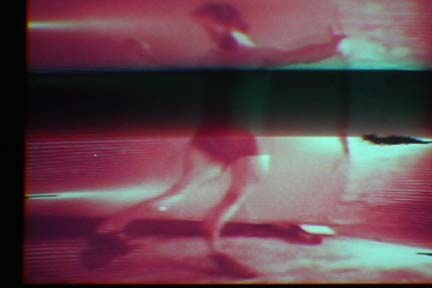
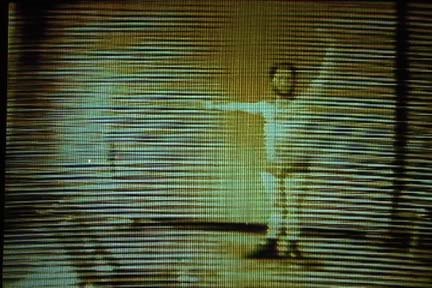
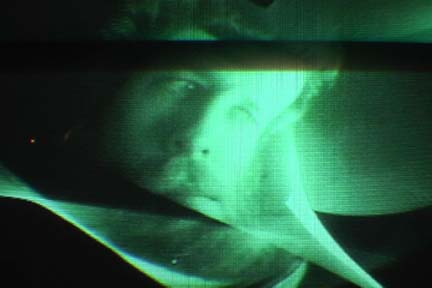
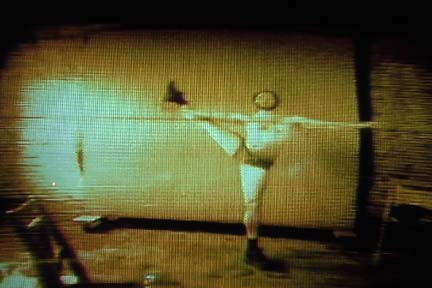
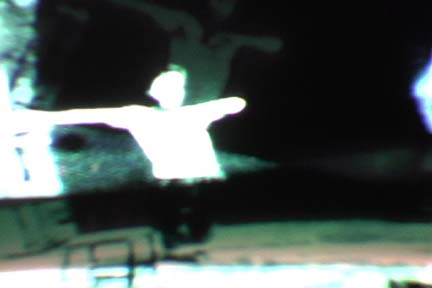
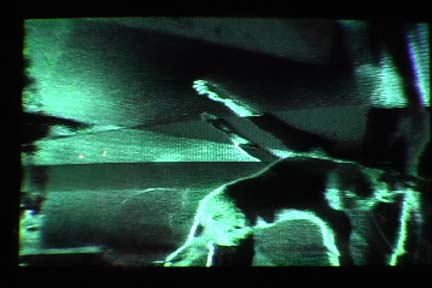
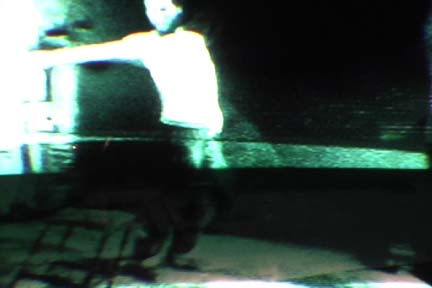
More Images from Experimental TV Center


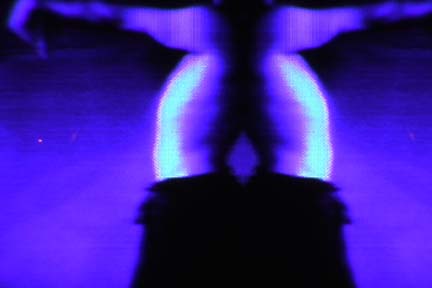
These movement studies were shot on-site and were processed through various analogue video filters. It was an amazing experience to work with tools that re-date digital media. These images are pulled out from over four hours of filtered video footage.

Experimental Television Center 2005 residency


Tuesday, September 12, 2006

Connected Dots

Connecting dots from the 20th century

I am humbled, inspired and influenced by the artists who are committed to pushing the boundaries of their chosen forms – trying to address the fundamental issues of live art: content vs. abstraction, form vs. process and the audience and performer relationship.

Why are we making work?
How do we translate what we make to those we share it with?

I have been very influenced by work that references its own creation. A perspective that values the messiness of process, and recognizes that the story of the process, in the end, becomes the gold of the work.
When successful, dance/art can open up a satisfying paradox – producing work that feels simultaneously disorientating and familiar. That is the balance that I strive for– the state of being lost and found all at the same time.

I thought that it would be appropriate to mention just a few of the predecessors that have had a deep influence on me choreographically. This is by no means a proper, or completely accurate historical chronology, but rather, some of the dots that I have connecting over the course of the past fifteen years. Not listed in this passage are numerous teachers, choreographers and the many somatic/improvisation-based artists that have had their own deeply enriching imprint on me.

The list:

Vaslav Nijinsky - an innovative choreographer and performer. He defied conventional expectations and opened the door for a re-definition of what ‘classical ballet’ is. He is modern. He was already boldly hybridizing the classical and modern forms several decades before his time.

Oskar Schlemmer - was a multi-media artist who for a period of time directed the Bauhaus School. He established the first Performance Art program for a college. He was a sculptor who directed dancers to interact with his sculptures, evolving into a choreographer. He evolved into a choreographer and produced many interdisciplinary dance performances and installations.

Bertolt Brecht - wove self-reference into his plays and foresaw post-modernism and Dance-Theater. He was an innovator for the theater using interdisciplinary practices and was a controversial advocate for socialism. He even incorporated film projections into his plays back in the 1930’s (I find that interesting as it somehow still seems contemporary to use projections in live performance all these years later).

Marcel Duchamp - with his Ready Made theories, exposes a new frontier for artistic expression. From him on, the can of worms is open and everything can be deemed art if you see it as such.

George Balanchine - is creating works that strip away all sentimentality and décor creating a pure and minimal ballet form - Neo-Classical Ballet.

John Cage - puts Duchamp’s notions into practice and follows a methodology that champions the elements of randomness, chance, coincidence and accident, among others.

Robert Ellis Dunn - who was an assistant to Cage and an accompanist for the Merce Cunningham Dance Company, took Cages process based ideas and translates them into movement composition classes that looked at improvisation as a legitimate form in itself. For several years during the early sixties, he worked with a group of young dancers who gave their first public presentation of these sessions at the Judson Church in New York. The group went on to notoriety as the Judson Church Group and progresses dance into a new Post-Modern era.
I find it fascinating that there isn’t more popular acknowledgement of Dunn’s contribution. It seems that so much would never have happened if it weren’t for him.

Steve Paxton and Trisha Brown - both dancers from the Judson Church Group and the Grand Union, went on to contribute some of the most important developments in dance, notably Contact Improvisation, Release Technique and System based choreographies.

Pina Bausch - begins to produce large-scale theatrical works that become associated with the development of Dance-Theater. It will draw heavily from its lineage from earlier German expressionist pioneers such as Brecht, Laban and the Bauhaus, amongst others. Her vision has pretty much influenced every theater and dance director working today.

William Forsythe – receiving influence from the work of Laban, Brecht and Trisha Brown plus philosophical and architectural studies, went on to infuse these sources into a language that used the classical ballet syllabus as the raw vocabulary to speak through the voice of improvisation. He created a new paradigm and busts open certain conventional attitudes towards how Classical Ballet is viewed and thus makes the big leap – bridging Classical Dance forms and Post Modern processes. He has attempted to strip the culture of ballet from the function of ballet, reducing it to its bare linguistic material. That is in essence a post-modern premise. The independently pointed directions of Classical and Modern dance ideas converge.

This brings us to the point in contemporary (presentational & ballet-based) dance where some of us find ourselves today. We are classically trained and are producing interdisciplinary work, improvising and working on-site. We are speaking through classical vocabulary but it doesn’t resemble its original form anymore. We are emersing into the information of somatic and social practices. Basically, a new mindset is emerging. The older definitions of Modern or Classical are shifting again and the front edges of the waves of change carry a blurred face.

I feel very fortunate to be working at this time in dance history where the perspectives of form and process are being melded and we can move away from the binary mindset (ballet vs. modern – or - learned movements vs. natural movements ect…) that only seems to limit a truer potential for dance and human expression.

Monday, September 11, 2006

Influences In Process

This is another archived rumination on creative process and some of the influences that have informed my work, 2003.


I think the one main book that has artistically inspired me, which I picked up during my five minute Zen phase a few years ago, is Zen Mind, Beginners Mind by Shunryu Suzuki-Roshi. The entire book is interesting but the main chapter that gets me is, Beginners Mind. It's focuses on the importance of always maintaining a beginners mind in what ever we pursue. It has been increasingly relevant to me in the practice of teaching, because i have found that the biggest barrier students struggle with in their ability to aproach new information is to maintain an open and untainted mind. This is even more important for the teacher or the 'expert'. That I think is the point, as long as there is no 'finishing point' to learning, we can always be open to new ideas and learning. I think this lesson becomes more relevant with the more advanced somebody becomes in their practice. So I find a deep support and humility in remembering to not get caught up in thinking I know everything in my field - and to remember that it is the 'not' knowing that is the most important aspect of wanting to know. We culturally freak out if we 'dont know', and that is precisely what holds us back from a depth in a creative process. We need to not know in order to ask the questions we are exploreing, otherwise there would be nothing to explore in the first place. Or, even worse, as is often the case, people just 'tell' you what you are supposed to think. I think it is the 'asking' rather than the 'telling' that
brings people into a conversation through art.The chapter talks about a baby who is empty of ideas, and therefore everything has a deep resonance and meaning. As we learn more we assume certain outcomes and assume certainties. We also become dulled by repetition. In the book he uses the example of zazen practices (sitting meditation), that when you first start it is all new and easy to hold excitement and focus, but after two three four or a thousand times it gets harder to maintain the sense of doing it for the first time. You have to work harder to empty out what you think you know and be able to fill up as if it’s for the first time. We only can bring in information and experience if there is openness of space to fill it in with. If we start from a point that already purports to 'know' than there is no room to fill in new 'knowing'. I find this is extremely difficult to find. This may all sound spiritual and philosophical, but I think it’s really basic and deeply true for anyone who has struggled to find greater depth within their work – whatever the medium or profession. When I was a young dance student all I was focused on was becoming an 'expert', now when I look around at all of the 'experts' they often seem lacking (I am not speaking to the measurability of technique but to the poetry of creation). Because they hold ideas in the past as though they are ideas of the present, and that is impossible, as we are always just arriving into our present.

Notes from a Foundry project 2003

The Foundry is on of my ongoing projects. It is a contemporary dance company based in San Francisco that I co-founded in 1998. I am still an Artistic Associate involved in its directions, even though I have re-located to Holyoke Massachusetts. These notes were written upon the completion of the Fleshing Memory Project 2003. These notes reflected our intentions and feelings towards our creative process, and in many regards, although not completely, still hold weight.
The Foundry created The Fleshing Memory in 2002-03, during a Wattis Artist in Residency at the Yerba Buena Center for the Arts in San Francisco California. The Fleshing Memory was included in the Bay Area Now 3 exhibition.


Final piece

The final performance piece (i.e. product) is an important part of the project, but ultimately a detail among many. The focus on the presentational aspect of the art must serve to transfer the greater ideas being explored. The greatest value of the work lies within the process itself, and although the translation of a process within a work is inevitably a coded and difficult task to accomplish, it is the task we strive toward.

The Fleshing Memory, served this point. It was our explicit interest to have an opportunity to create a new body of work generated from within the chosen non-public subterranean spaces within YBCA. This was attempted and accomplished. We are essentially ballet choreographers whose uncharacteristic approach to choreography is best exemplified within one key detail, we choreograph on site (in very rare instances within a dance studio) in response to the site. This is not to say that we are ignorant to the long history of site-specific work, but given the history of ballet, it is mildly noteworthy.

The development of a new work and a new process is always a mysterious endeavor. We approach our process in the way I imagine a journalist approaches writing a story. The journalist cant know what the story will be before it is investigated. Like the journalist, we continue our investigations right up until the deadline irregardlessless of what we find or how it makes sense. We aren't interested in creating a performative logic (i.e. a shape which adheres to established understandings of correct or comfortable viewing standards), but rather we attempting to present the closest state to the moment of creation (i.e. process, the journalists story) we can.

For example, how does pink paper become realized within a piece that explores parallels between architecture and people? We created this metaphor, as does any artist who asks questions of nonexistent answers. It is this art history, of abstraction and process and ideas that we reference, not that of presentation or decoration. As long as there are expectations of good or successful, the greater point of the art will be trivialized and lost. To objectify the work serves nothing more than the lowest common denominator of entertainment.

list form 2002

forms of flow
idea spaces
openness
intention
real time composition
choreography is fluid
depth
speed
quality
temperament
spacial relativist
spacial relationships
listening
awareness
choice
editing is ok
editing is work
we are the work
no wrong decisions
the impulse as the beginning
what is the beginning of movement
where does movement come from
where does stillness come from